Home → Stories → We Spent Our Last Cafe Budget on an Amethyst Geode and People Came to See It
We Spent Our Last Cafe Budget on an Amethyst Geode and People Came to See It
K
Published
English edition of the original Chinese article.
The mover looped a strap around the amethyst geode, reached behind its base, then stood up.
“We may not be able to move this as it is.”
I assumed he was about to raise the price. “Didn't we already confirm the dimensions and photos?” I asked, a little too sharply.
Instead of answering, he shone a flashlight at the bottom. Where the geode met its black base, a pale gray crack ran along the edge. A small section had lifted like peeling plaster.
“It looks like there's been a repair, and there may be filler inside the base. Lift it directly and it could split.” He tapped the side. “Something this heavy could hurt someone if it breaks.”
My wife crouched beside the crack, deep in thought.
Watching her, I remembered the first time we had seen this enormous geode in a crystal shop years earlier. She ran a hand over its shell and told me, with complete confidence:
“Trust me. It'll bring us prosperity.”
The geode was our biggest argument before opening
Our cafe stood on a corner in the old part of a rainy city. There were offices, apartment buildings, and long-established shops nearby, but it was not a tourist area. Foot traffic was limited.
After signing the lease, we divided our savings between renovations, coffee equipment, ingredients, the deposit, and a reserve to cover our first few months of living expenses.
Near the end of the renovation, one final amount remained. It could buy a new, high-end commercial espresso machine. Or it could buy the huge amethyst geode my wife wanted.
I did not have to think about it. I wanted the machine.
She said we could buy used equipment and make up the difference with our pour-over skills. What the cafe really needed, she thought, was something people would remember.
When she took me to see the geode, the seller dimmed the room and left one warm spotlight on it. Deep purple crystals rose from a dark shell. It looked like an impossibly elaborate cave.
I admitted it was beautiful. Then I saw the price and liked it a lot less.
“We're opening a cafe, not a crystal shop.”
“There are already plenty of cafes,” she said.
The seller described amethyst geodes as symbols of prosperity, stability, and wisdom, suitable for an entrance, a counter, or a business's feng shui wealth corner. My wife listened closely. I imagined the money leaving our account and my espresso machine slipping farther away.
We said nothing on the way home. Just before we reached the door, she said, “People have to come inside before they can find out the coffee is good.”
At the time, it sounded like an excuse for an expensive rock.
We did not buy the new machine.
In the first month it brought us nothing
The geode stood beside the counter, facing the entrance. Before opening each morning, my wife dusted its base and adjusted the light.
Sometimes she moved a nearby plant. Sometimes she placed a coin in front of it, then removed everything again. She said the area needed space for energy to flow.
I did not believe in that, but I left her alone. The geode's placement was not what worried me. The empty tables were.
Friends and family visited during the first few days. By the second week, we sometimes had only two or three occupied tables all afternoon. When it rained and the street emptied, the used machine's steam wand sounded especially loud.
One day it rained from afternoon until closing. The first visitors came in to use the restroom. The next ordered one coffee, stayed all day, then asked for a discount.
I sat beside the geode adding up the day's sales. “Maybe you've put it in the wrong place?” I asked deliberately.
She paused with the cloth in her hand. “Maybe people haven't noticed us yet. We need a little time for word to spread.”
I hated that answer. If business was slow, the crystal had not started working. If business improved later, it could take the credit. Either outcome seemed to fit.
I did not say all of that. I closed the ledger.
That night, for the first time, we did not close up together. She stayed to rearrange the tables. I left on my own to buy supplies.
Our first real line of customers came for photos
Things began to change on another rainy day.
A young woman came in for shelter and ordered a hot drink. She sat by the window, then noticed the geode and started taking pictures from different angles.
Warm light fell into its purple interior while steam from the coffee machine drifted behind it. She captured the scene and asked whether she could share the photo publicly.
We said yes, enthusiastically.
The next morning, our social account had new notifications. Her photo had been shared several times, and she had tagged the cafe.
That afternoon, customers arrived holding their phones. Their first question was not about the menu.
“Can I sit next to the geode?”
Over the following days, more people came to take pictures. Some asked what amethyst was supposed to do. Others brought friends. A few photographed it without buying anything, then left.
Those last visitors annoyed me. My wife thought they helped. Even if they did not buy coffee, they might share a photo that brought someone else in.
She experimented with lighting, arranged seats that would photograph well beside the crystal, and added a purple drink to the menu. She did not claim it would attract money. She wanted the cafe to feel visually consistent.
The geode gradually became our signature.
One customer said the cafe felt unusually peaceful. Others mentioned it in map reviews. Some told us they liked sitting beside it after a difficult day at work.
Some became regulars. They began remembering our coffee, our desserts, and their favorite seats.
Sales did improve.
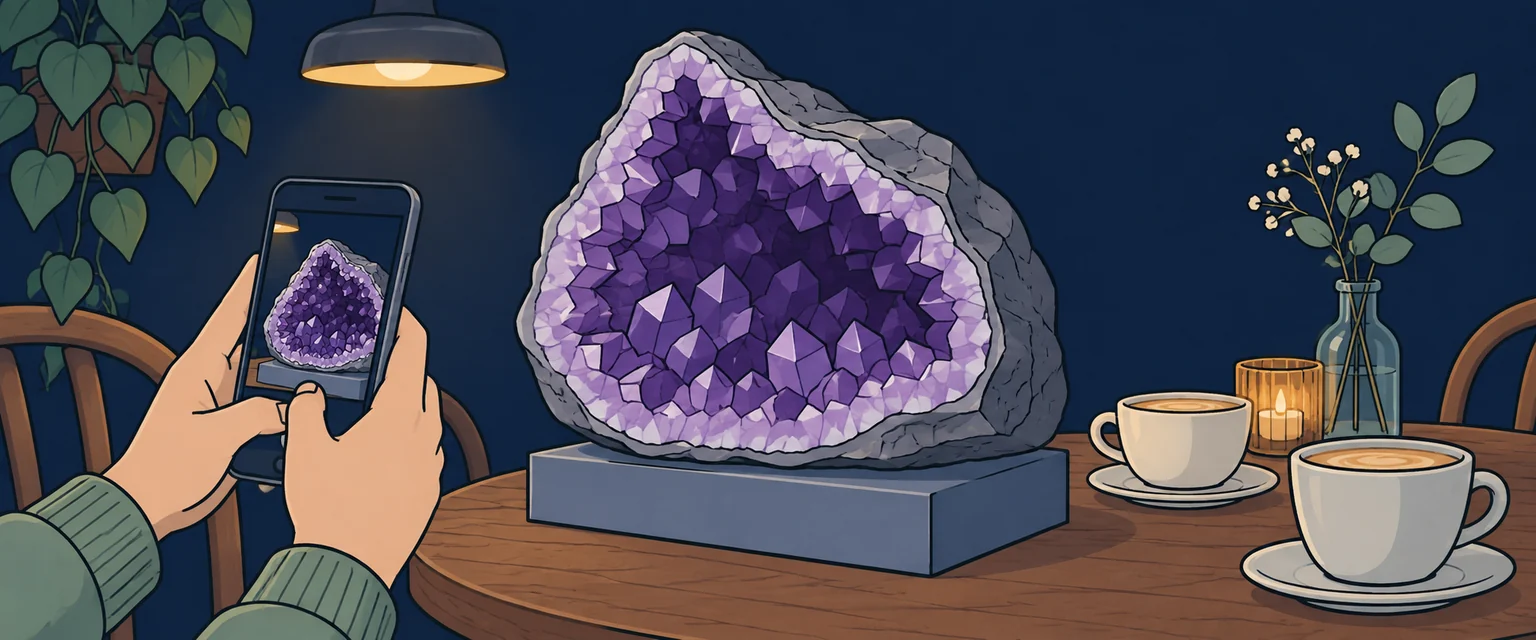
- A scene from the story
- The geode, cafe and visitors taking photos illustrate the story's turning point: being noticed.
Had it brought prosperity or had people finally noticed us
My wife never said, “I told you so.” But she looked quietly pleased whenever she tended to the crystal.
I kept insisting that the customers came because of photos, social exposure, lighting, and her changes to the space. None of that proved the amethyst had changed our luck.
“Without it,” she asked, “what would have been in that photo?”
I had no answer.
After closing one evening, I asked whether she had bought the geode because she believed it would attract prosperity, or because she had already imagined it as the cafe's centerpiece.
She thought for a moment and admitted it was both.
Once the renovations were done, she had noticed how familiar the cafe looked: wood tables, gray walls, warm lights, a few plants. It photographed well enough, but nothing would stay in a customer's memory.
“I do believe amethyst helps a space feel grounded,” she said. “But I also thought we needed something special. Not something that looked cheap.”
She had not simply bought a promise of better luck. She had bought a focal point, a conversation starter, and a little reassurance during the frightening first months of a new business. Back then, she had compressed all of that into one sentence: “It'll bring us prosperity.”
When we relocated nobody wanted to lift it
Several years later, we could not renew the lease. We found a new space in another neighborhood with better light and larger windows.
Everything else was easy to put on the moving list. The geode was not.
It weighed more than it appeared to, had sharp crystal edges, and offered no easy place to grip the base. Most movers were reluctant to handle it.
The original seller said they could deliver geodes but could not help relocate ours. Eventually, we found movers experienced with large works of art.
That was when one of them found the crack.
As the strap tightened slightly, we heard a faint crunch from the base. Everyone stopped. My wife looked more distressed than she had over our early sales figures.
What fell away was not amethyst but a small piece of old filler. The mover explained that the geode, base, reinforcement, and bonded sections carried loads differently. They could not treat it as one solid stone and simply haul it up.
He advised us to check the structure before deciding how to secure and move it. For a valuable object, we should also keep photographs, dimensions, weight, records of existing damage, and valuation information. Otherwise, any damage in transit would be difficult to sort out.
After years of ownership, we realized that beyond the seller's promises about its benefits, we knew almost nothing about the geode.
Identification did not give us a simple real or fake answer
We arranged an examination of its material, structure, and repairs.
The main body was a natural amethyst geode, not glass or an imitation assembled from small crystal fragments. Purple crystals grew within the host rock, with natural color zoning and differences in crystal form visible in some areas.
But the bottom had been cut, filled, and bonded again. Several exterior areas had also been worked on.
The claimed origin could not be established from appearance alone. Without traceable mining, import, or other records, it remained information supplied by the seller.
It was natural. It had also been repaired.
It had market value, but it was not an untouched specimen with no repairs.
“Did we overpay?” my wife asked. “Should we see if the landlord wants to buy it?”
I answered immediately: prices change, and retail prices also cover transport, premises, selection, and display. We had bought it years ago; debating that now would not help much.
Later, I realized I had been defending the geode.
Our immediate problem was protecting it and getting it safely to the new cafe. Whether we had paid too much was another question. Whether it attracted prosperity was no longer the point.
We had heard about benefits but not the transaction details
We searched our old records and found only a payment record and a few photos.
The description said “natural amethyst geode.” It did not explain how much of the total weight came from the base, or describe cutting, filling, bonding, and repairs. Origin had been discussed verbally. Transport and damage responsibilities were not fully recorded.
It was not an imitation. We simply had not known enough about what we were buying.
At the new cafe we argued about placement again
My wife wanted it diagonally across from the entrance. She said it would gather incoming energy there, and customers would see it immediately.
I objected. It was too close to the large windows, with prolonged bright light, and too close to the main walkway. Customers with bags or strollers might hit it.
We spent a long time over the floor plan. Eventually, we found a spot visible from the entrance, away from prolonged direct sun, and clear of escape and service routes. We reinforced the base and added discreet restraints.
She looked at it from the door. “This works, too.”
I knew we had found a compromise.
It rained again on opening day. Our first customer folded an umbrella and looked around. Before picking up a menu, they said:
“Your geode looks even better here.”
My wife smiled and glanced at me. I did not ask how much money it had attracted that day.
I can only answer half the question
The geode did not make coffee, control costs, or apologize to disappointed customers. We stayed in business by opening every day, improving the menu, maintaining quality, and learning how to make a place worth remembering. My wife understood that last part before I did.
But many people did first walk through our door because they had seen the geode in a photo.
If “attracting prosperity” means an unverified mineral power, I have no evidence that it worked. If I break down what happened, it gave us a distinctive image, something to talk about, and a story people wanted to share. Those things really did bring customers.
She still believes the amethyst gathered prosperity for us. I think she saw something I did not.
We no longer need to decide whose explanation wins. I touched the crystal bracelet I had bought a few days earlier and thought about it.
I still cannot say whether that geode changed our luck.
But I know many customers first came because of it.
Notes on buying a large geode
A geode's value is not determined by size alone. Crystal color, condition, zoning, form, host rock, extent of repairs, overall appearance, and market demand can all matter. More weight does not automatically mean more value: a base or filler may account for part of that weight.
Before buying a large geode, ask:
- How are the geode and base weights recorded?
- Which areas have been cut, reinforced, bonded, repaired, or finished?
- Is the origin supported by traceable records?
- How should it be moved, secured, and cared for?
- Could prolonged sunlight, heat, or damp conditions affect it?
- Who is responsible for damage during delivery?
- Can an expensive piece come with independent identification or valuation records?