Home → Insights → Crystal care
The Cost of Over-Cleansing: A Gemologist’s Guide to Crystal Care
Edison Cheng
Diploma in Crystal Identification, Gemmological Institute, China University of Geosciences
Published 4 September 2026
Crystal cleansing is everywhere right now. If you browse any online crystal community, you will find endless guides on how to "purify" your stones. The holistic community often views gemstones as energetic sponges that require constant resetting.
But there is a catch. From a gemological standpoint, some of these methods do real, physical damage.
We see the aftermath in the lab all the time. Beautiful, high-grade crystal bracelets come in looking ruined. They turn cloudy, fade in color, or snap unexpectedly. Most of the time, the owner was just trying to follow a trending cleansing ritual.
You can respect the spiritual side of crystals without destroying them. Crystals are tougher than social media claims. They do not need a deep chemical or physical reset every single week. In fact, aggressive cleaning routines usually do more harm than good.
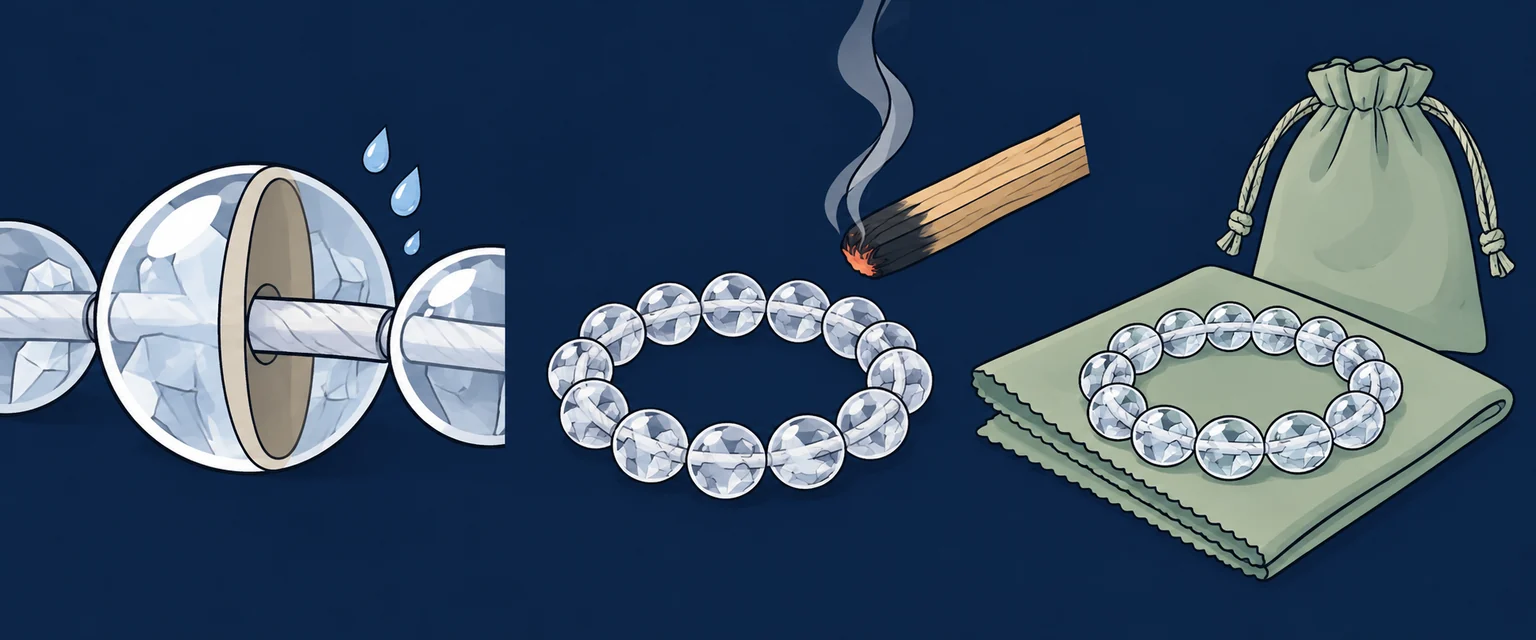
- Drill holes and cords
- Check the cord, drill holes and fittings after cleaning.
- Heat and residue
- Keep direct heat and residue away from jewellery.
- Everyday storage
- Choose cleaning methods for the material and store it dry.
Water and Cords: The Hidden Mold Issue
Soaking a bracelet in water or sea salt is a popular ritual. For a solid, un-drilled piece of quartz, a quick rinse is perfectly fine. The problem starts when you submerge drilled gemstone beads and elastic jewelry.
Most modern crystal bracelets are strung on multi-strand elastic cords. These cords are made of porous synthetic rubber or nylon. When you submerge the bracelet, water gets trapped inside the tiny drill holes of the beads. It gets stuck there.
Air cannot circulate inside a drilled gemstone channel. Because of this, the trapped water stays damp for days.
That dark, wet space is an ideal breeding ground for mold. For transparent or pale stones—like clear quartz, aquamarine, or light amethyst—this internal mold eventually ruins the look. It appears as a dark, ugly smudge inside the bead. You cannot wipe it off because it is inside the stone's core. Over time, this constant dampness also rots the elastic cord. The string turns brittle, degrades, and eventually snaps without warning.
Smoke Cleansing: Heat and Buildup
Smudging with dried sage or Palo Santo wood is another common practice. It avoids the water issue entirely, but it introduces two new problems: thermal shock and surface buildup.
Gemstones are hard, but they can be brittle. Natural quartz often contains tiny, microscopic internal fractures or fluid pockets from when it formed deep underground.
Holding a crystal directly over hot smoke creates a sudden temperature shift. This creates physical stress inside the mineral lattice. If that heat hits a pre-existing internal crack, the crack can expand. This can cause the bead to turn cloudy, chip, or break in half.
There is also the smoke itself. Burning plants release natural oils, tars, and carbon soot. If you smudge your jewelry frequently, these oils coat the outside of the beads.
This leaves a sticky, microscopic film on the stone. It kills the natural, glass-like shine of the quartz. The beads start to look foggy and greasy. Because plant tar does not dissolve easily in water, this layer is very difficult to clean off without harsh solvents.
Sunlight: Fading and Fires
Leaving crystals on a sunny windowsill to "recharge" is a massive risk. For colored stones, it is one of the fastest ways to ruin their beauty.
The bright colors in amethyst, rose quartz, and smoky quartz are highly sensitive. These colors come from unstable atomic bonds and trace elements inside the crystal structure.
Direct ultraviolet (UV) light breaks these bonds down. If you leave a purple amethyst or a pink rose quartz in the sun, the color will fade. This sun bleaching is permanent. Once the color is gone, no gemological treatment can bring it back. You are left with a dull, grayish stone.
Spherical crystals present an even bigger danger in the sun. A clear crystal ball acts exactly like a magnifying glass. If you place a crystal sphere on a sunny windowsill near curtains, paper, or wooden frames, it will focus the sunlight into a burning hot point. It can literally start a fire. It is a genuine safety hazard for your home.
Safer Ways to Maintain Your Collection
You can keep your rituals alive without risking your jewelry. Quartz is an incredibly stable mineral that handles normal wear with ease. A gentle maintenance routine once every month or two is plenty.
If you want to protect your pieces, try these safe alternatives:
- Sound Waves: Use a 4096 Hz tuning fork or a singing bowl. The acoustic vibrations work without touching the stone. This method involves no water, no heat, and no chemicals. It is safe for every mineral and string type.
- The Selenite Method: Place your jewelry overnight on a dry slab of selenite or a large quartz cluster. This allows you to follow a traditional metaphysical reset without introducing any physical variables like moisture or heat.
- Indirect Light: If you like nature-based routines, use the moon instead of the sun. Moonlight carries no heat and no destructive UV rays. Leaving your jewelry on a dry, shaded window sill overnight is completely safe for color-sensitive stones.
In short, natural gemstones survived millions of years underground before they were mined. They are built to last. By stepping away from harsh, repetitive cleaning habits, you are showing true respect for the physical stone.
Recommended Gemological Resources
To learn more about the physical limits and proper care of gemstones, you can read the public consumer guides provided by these major industry bodies:
- Gemological Institute of America (GIA) – Jewelry Care and Cleaning Guide
The standard industry reference on how heat, light, and moisture affect colored gemstones and jewelry materials. - The Gemmological Association of Great Britain (Gem-A) – Gemstone Testing and Preservation
An overview of mineral structures, focusing on how internal fractures and inclusions respond to environmental stress. - American Gem Trade Association (AGTA) – Gemstone Information Manual
A guide for professionals and consumers regarding the long-term stability and preservation of natural gemstones.