The Fire Quartz Fraud: Why Those Bright Red Crystals Might Be the Work of an Oven
Edison Cheng
Diploma in Crystal Identification, Gemmological Institute, China University of Geosciences
Published 21 September 2026
Walk into any mineral boutique showcasing modern, bohemian designs. You will notice a very popular type of quartz crystal. Inside the clear stones, you can see bright flakes of deep red and golden yellow. They look like frozen explosions or tiny blooming flowers.
In the retail market, sellers give these stones exciting names. They call them Fire Quartz, Hematoid Quartz, or Golden Healer.
The stories on social media marketplaces sound like a beautiful accident of nature. Sellers tell you that millions of years ago, iron water seeped into the natural cracks of the growing crystal, leaving behind these fiery inclusions.
It sounds like a romantic geological story.
Many collectors invest good money into this natural art. But if you look at some of the most vibrant pieces sold online, the true story is different.
In many cases, those bright red patches are not ancient iron inclusions. They are just cheap chemical dyes forced into a broken stone inside a factory pressure chamber.
What is the actual science behind these colorful cracks? How can buyers understand the real market value? Let's skip the retail folklore and look at the facts.
1. Natural Inclusions: The Earth's Imperfect Art
First, let's look at the science. Genuine included quartz is a fascinating material.
In gemology, we classify these pieces as included quartz. Millions of years ago, as the silicon dioxide crystallized deep underground, tectonic shifts caused the growing stones to develop tiny internal stress cracks. If underground fluids rich in iron passed through, the liquid seeped into those microscopic fissures.
Over time, the water evaporated. But the iron stayed behind.
The trapped iron slowly oxidized, turning into microscopic plates of hematite or goethite. Hematite creates the deep red color. Goethite provides the golden yellow. When light enters the clear quartz, it bounces off these metallic flakes, creating the famous fiery flash.
This is a normal geological event. It happens all over the world.
But nature rarely follows a perfect blueprint. Natural inclusions look slightly irregular under a basic lens. They resemble tiny, natural scales. At certain angles, they even flash with a rainbow sheen because of light interference. The color distribution is uneven. Some areas look dense, while others remain completely colorless and empty.
2. Thermal Shock and Dye: The Factory Makeover
In the commercial gemstone trade, a flawless appearance always sells faster than science. That is just market reality.
Natural fire quartz with intense, uniform colors and clear crystal bodies is relatively scarce. When demand outpaces supply, manufacturers rely on a standard artificial process called fracture-filling and dyeing.
Factories take abundant, low-cost clear quartz that has no natural inclusions. They heat the raw stones inside industrial ovens to very high temperatures.
When the quartz is extremely hot, they drop it directly into ice-cold water.
This extreme temperature shift causes a physical reaction called thermal shock. The sudden contraction forces the hard stone to shatter internally, creating a massive network of tiny cracks. The trade calls this "crackle quartz." Next, the factories place these shattered stones into high-pressure chemical tanks. They force liquid red or yellow dyes, mixed with clear epoxy resin, deep into the fresh cracks.
The resin hardens, sealing the cracks. The broken stone becomes smooth again. But the trapped dye creates bright, intense artificial colors that mimic natural fire quartz.
However, this factory shortcut leaves clear physical clues. Because the dye is forced in artificially, the color tends to pool unnaturally at the intersections of the cracks, forming dark, heavy lines. Furthermore, if you place these treated pieces under a standard long-wave UV light, the epoxy resin inside the cracks will often glow with a bright yellow-green or blue-white fluorescence. Natural iron minerals stay completely dark and inert.
Under global trade standards, selling treated stones is legal. But the dealer must provide clear disclosure. The issue arises when dishonest sellers hide the dyeing process. They take a cheap piece of crackle quartz and sell it at a premium price as a rare, untreated natural wonder. Knowing the true nature of the material is your best protection.
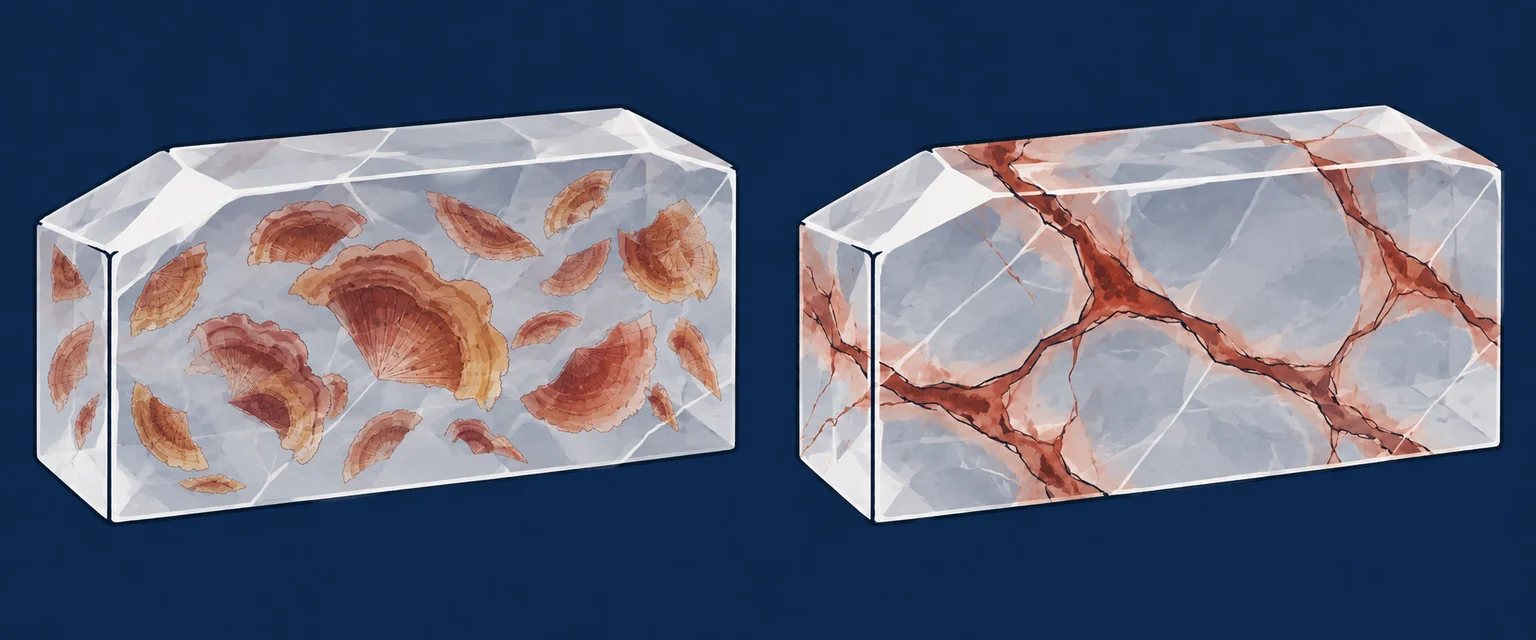
- Rounded and fan-shaped features
- Curved bands and radiating textures illustrate the red and yellow flower-like appearance discussed here.
- Colour along fissures
- Colour can concentrate along fissures. Shape or colour distribution alone does not establish whether a stone is natural or treated.
3. The Structural Blind Spot: A Recipe for Hidden Fractures
Beyond the disclosure debate, fire quartz has a major physical weakness that sellers rarely mention. It is highly vulnerable to breaking.
Pure, clean clear quartz is durable. It has a solid Mohs hardness of 7 and handles daily wear easily. But quartz full of fractures behaves very differently.
This weakness comes down to basic physics.
Whether the cracks were made by nature or forced by thermal shock, fire quartz is a structurally compromised material. It is full of internal boundaries. In treated pieces, these cracks are held together only by soft resin. When the gemstone takes an impact, the energy cannot travel smoothly through the stone.
This creates thousands of invisible stress points.
This becomes a real issue in daily life. If you wear a fire quartz bracelet every day, the beads will bump against things. A minor clip against a granite kitchen countertop or a metal car door can be disastrous. If that everyday impact strikes a major fracture boundary, the force concentrates along that weak line and pops the bead open.
Over time, exposure to heavy sweat, perfumes, or summer heat can also degrade the artificial resin inside treated stones. The bright red colors can turn cloudy, and the surface can develop fine, secondary cracks. It is permanent physical damage that cannot be reversed.
4. Rational Collecting: Focus on Facts
Enjoying your collection requires looking past the trending market labels and seeing the physical reality of the material.
The modern marketplace is full of fancy names and manufactured stories. It is easy to spend a premium on a clever marketing script. But the raw, unedited imperfections left by our planet hold plenty of value on their own. They do not need a perfect color pattern to be fascinating.
When you look past the commercial legends, you can appreciate the true nature of the stone. You can focus on the unique flow of the real iron flakes and the actual history of the crystal. True value always comes from clear science, not folklore. We look forward to breaking down the physics behind more popular mineral trends in our upcoming articles, helping you shop with absolute clarity.
What to check before you buy
| Item | What it means |
|---|---|
| Trade names | Fire Quartz, Hematoid Quartz, Golden Healer |
| Gemological identity | Included quartz |
| Where the natural color comes from | Iron-rich fluids seeped into microscopic fissures, then oxidized into microscopic plates of hematite (red) and goethite (golden yellow) |
| What natural looks like | Slightly irregular, like tiny natural scales; a rainbow sheen at certain angles; uneven color with areas that stay completely colorless and empty |
| How the factory version is made | Clear quartz is heated in industrial ovens, dropped into ice-cold water to shatter internally, then dye and clear epoxy resin are forced into the cracks under pressure |
| Clues the piece was treated | Color pools unnaturally at the intersections of the cracks, forming dark, heavy lines; under long-wave UV the resin often glows bright yellow-green or blue-white, while natural iron minerals stay completely dark and inert |
| Where the legal line sits | Selling treated stones is legal, but the dealer must provide clear disclosure |
| Weakness both types share | Full of internal boundaries and thousands of invisible stress points, so an everyday impact can pop a bead open |
| How treated pieces age | Heavy sweat, perfumes or summer heat degrade the resin: colors turn cloudy and fine secondary cracks appear, permanently |
Industry References for Material Stability
- GIA (Gemological Institute of America) – Gem Encyclopedia: Quartz Quality Factors and Fracture-Filling Enhancements The official laboratory guide detailing the formation of internal fractures in quartz and the international identification standards for polymer-injected and dyed stones.
- AGTA (American Gem Trade Association) – Gemstone Information Manual: Code of Disclosure for Dyeing (D) and Filling (F) The standard trade rulebook regarding consumer rights and the legal requirement to fully disclose artificial color treatments and fracture fillings at the retail point of sale.