The Auralite 23 Story: A Closer Look at Crystal Structure and Value
Edison Cheng
Diploma in Crystal Identification, Gemmological Institute, China University of Geosciences
Published 16 September 2026
Walk through any major gemstone exhibition today. You will likely see a very specific type of quartz on display. It features rich purple layers capped with a deep red, chevron-shaped pattern.
The market prices for these pieces are often quite high. Sellers call them Auralite 23.
The commercial descriptions online are very compelling. Many sellers describe these stones as ancient wonders. They tell buyers that one single bead holds twenty-three different rare minerals from a billion years ago.
It is a beautiful concept.
Many collectors invest their savings because of this narrative. But let’s look at these stones under a real gemstone microscope.
The story changes. The reality is much more practical. In the scientific world, finding twenty-three different minerals inside a single jewelry bead is almost never possible.
What is the actual science behind this material? How do experts classify it? Let’s look at the facts.
1. Its True Name is Included Amethyst
Let's be fair to the stone. These crystals do have a unique geological history.
In gemology, we classify this material as included amethyst. They grew deep underground over a billion years ago inside ancient shield deposits. During their long growth cycles, the environment under the earth shifted. So, the growing quartz naturally swallowed up other tiny minerals nearby.
That is how the unique red chevrons formed. It is a completely normal natural event.
But the number twenty-three is a misunderstanding. Geologists originally tested a massive area of the mine. They found twenty-three different elements across the whole deposit. But a single jewelry bead is very small. Minerals need different temperatures and pressures to grow. Some minerals cannot physically form in the same exact spot.
Look into the actual laboratory tests. You only find a few regular guests. The dark needles are goethite. The red tops are thin flakes of hematite. You might also see a few shiny particles of pyrite.
So, you are not buying a twenty-three mineral superpower. You are buying a very unique variety of natural amethyst with heavy inclusions.
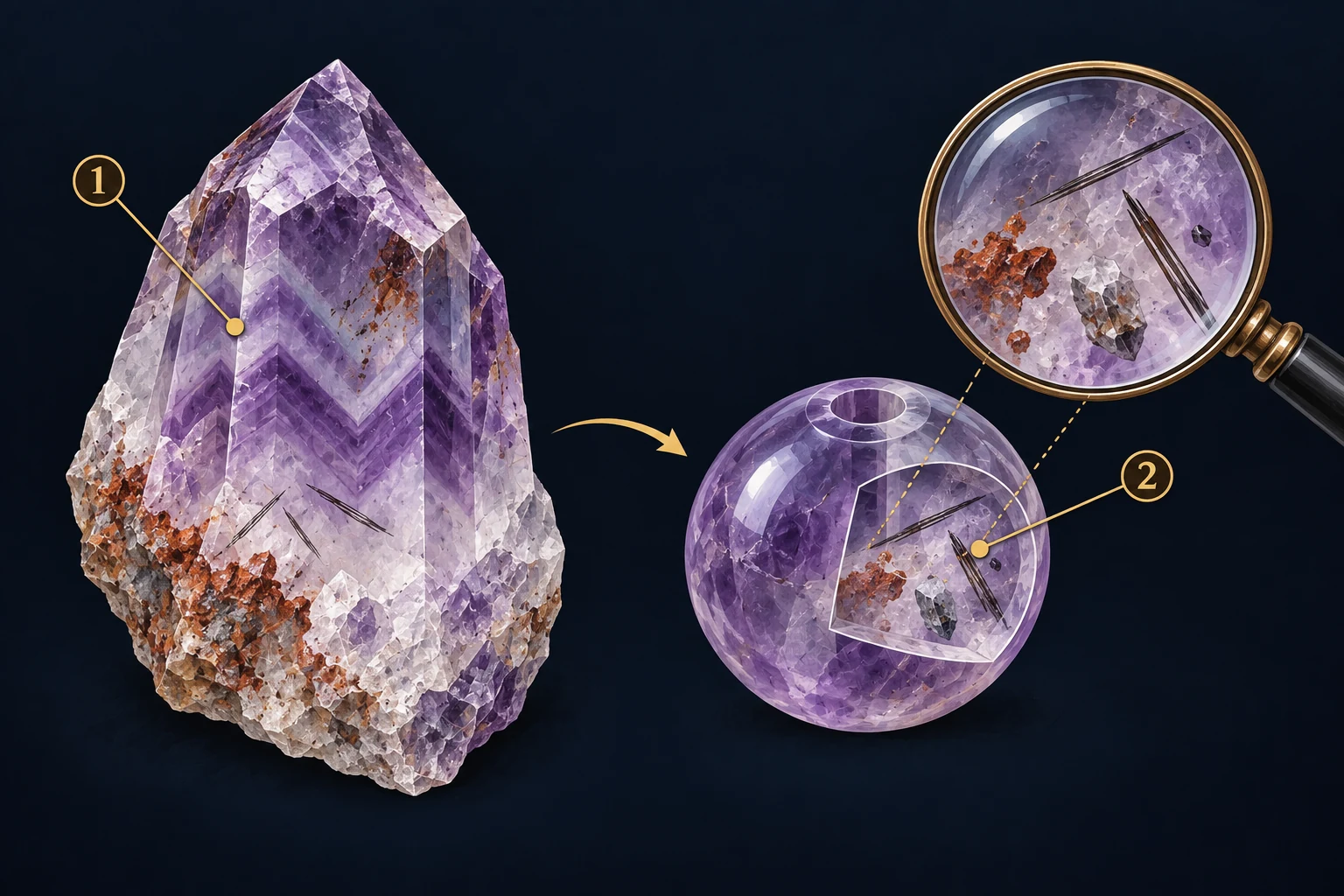
- 1Included amethyst
- The crystal contains differently shaped mineral inclusions.
- 2One bead, viewed closely
- Examine the inclusions in the individual sample; a trade name is not a count of its minerals.
2. Market Scarcity and Laboratory Realities
In the gemstone market, a romantic story always sells faster than science. That is just a reality of the trade.
These red-capped stones come from a very localized area. When the supply gets low, sellers raise the prices. This is a common commercial practice.
But send your stone to a reputable, independent gem lab. Look at the document they give you back. Under the species line, it will say: Natural Quartz. The lab might add a brief note: "Amethyst with multiple mineral inclusions."
A serious, professional gem lab will never write "Auralite 23" on an official certificate.
This creates a major blind spot for new buyers. People buy these pieces believing the twenty-three-in-one guarantee. Later, they try to get a formal appraisal. Then they find out the scientific community does not recognize the name. You paid for a commercial brand name, not a rare new mineral species.
We do not want to criticize this collection. Inclusions are like the ancient fingerprints of our planet. They are like old rain trapped millions of years ago. If you love the layered textures, it is a magnificent piece of natural art. But if your goal is to collect twenty-three different energies, your strategy might be starting on a misunderstanding.
3. The Physical Blind Spot: Why It Is More Fragile
Beyond the market talk, heavily included quartz has a serious physical weakness that sellers rarely mention. It is quite easy to crack.
Regular, clean purple amethyst is tough. It has a Mohs hardness of 7 and handles daily wear well. But amethyst stuffed with foreign metal needles and iron oxide flakes behaves very differently.
This vulnerability comes down to basic engineering physics.
The host quartz and the metallic inclusions do not blend into a seamless body. They are separate materials with different physical properties. When the jewelry takes an impact, the shockwaves travel through the hard quartz and the soft metals at completely different speeds.
This mismatch creates thousands of invisible stress points.
This gets tricky in real life. You wear your bracelet every day. The beads bump together. You accidentally hit your wrist against a granite kitchen countertop or a metal car door. If that bump hits a spot where an iron flake meets the quartz, the impact force concentrates along that internal line.
The bead might not split in half today. But you will see new, white fractures inside. The clear purple turns foggy. That is permanent physical damage. You cannot fix it.
Before You Buy: A Quick Reference
| Point | What it actually is |
|---|---|
| Gemological identity | Included amethyst — the species is quartz |
| What the certificate says | Natural Quartz, sometimes noted "with multiple mineral inclusions" |
| What "23" really means | 23 elements found across the whole mining deposit, not inside one bead |
| Common inclusions in a real bead | Goethite, hematite, pyrite |
| Why it cracks more easily | Metallic inclusions and host quartz have different physical properties, creating stress points under impact |
| What to avoid | Beads bumping together, hits against hard countertops or car doors |
| What the damage looks like | New white fractures, foggy color — permanent |
4. True Value Starts with Clarity
Enjoy your rocks. But focus on facts, not hype.
The internet is full of fancy names. It is easy to waste money on a clever script. But the raw marks left by nature are beautiful enough on their own. They do not need an inflated numbers game to hold value.
Look past the commercial legends. Appreciate the real stone. Focus on the color bands and the actual flow of the inclusions. True value always comes from clear science, not manufactured folklore. We look forward to exploring the physics behind more trends in our upcoming articles, helping you shop with absolute clarity.
Industry References for Material Stability
- GIA (Gemological Institute of America) — Gem Encyclopedia: Included Quartz and Trade Names. The official laboratory guide explaining the growth mechanisms of host crystals and the standards for naming quartz with heavy mineral inclusions.
- Mindat.org — Amethyst with Inclusions from Ancient Shield Deposits. The public earth science database, providing peer-reviewed data on mineral paragenesis and the structural stability of shield-mined quartz.