Home → Stories → Nobody Wanted Grandma's Crystal Bracelets Until We Had Them Examined
Nobody Wanted Grandma's Crystal Bracelets Until We Had Them Examined
Mina
Published
English edition of the original Chinese article.
After Grandma died, everyone arrived on time for once. We were dividing the jewelry she had left behind.
Several boxes sat on the living-room table: two gold necklaces, a diamond ring, pearl earrings, and some old-looking jade pieces. My aunt kept the list. My oldest uncle held a calculator. My cousin looked up gold resale prices.
There was also a bag of crystals. Nobody paid much attention to it.
The bag nobody wanted
It was a clear zip-top bag containing more than a dozen bracelets in purple, pink, brown, and green. Some had fine golden strands inside. The beads knocked together with a sound I had known since childhood.
“Does anyone want these?” my aunt asked.
Nobody answered.
I pulled the bag toward me and found a dull-looking bracelet filled with dark yellow lines. Its elastic was loose. The beads did not shine like the jewelry in the boxes.
But I recognized it.
Grandma wore it to the market in the morning, to mahjong in the afternoon, and while watching television at night. The beads tapped the kitchen counter when she chopped vegetables and slid down her wrist when she reached for the remote. As a child, I sometimes fell asleep against her legs with those round beads pressing into my cheek.
“I'll take this bag,” I said. “You can have the rest.”
My uncle checked that I meant it. “These aren't worth much. You were her favorite. Are you sure?”
I nodded.
I did not know crystal prices or whether the bracelets were genuine. If I could keep only one of her things, I wanted the bracelet marked by her everyday life.
Everyone else was looking at the jewelry boxes
Grandma loved jewelry, but never discussed what it cost. Nobody dared to ask.
Compliment her necklace and she would say she had worn it for years. Ask where she bought a crystal and she would say a friend had taken her there.
She believed different crystals had different benefits: amethyst for thinking clearly, rose quartz for relationships, green phantom quartz for prosperity, and smoky quartz for a steadier mood.
The bracelet with golden lines was clearly her favorite.
She said it brought her good fortune. When money was tight, she wore it while helping Grandpa run their little market shop. Business gradually improved. Even after the shop closed, she wore it daily. By then, she said, it was not about making a fortune; she was used to having it on.
Most of us smiled at those stories. I did, too.
When we divided her belongings, gold, diamonds, and pearls naturally got our attention. The crystals had no original boxes, receipts, or reports. They were in an old plastic bag and looked like inexpensive accessories collected from markets and tourist stops.
I took them home and put them in a drawer.
Two months later, I decided to restring the loose bracelet and brought it to a neighborhood jewelry shop.
The jeweler asked before cutting the cord
He placed it on a white pad, turned on a light, and examined several beads with a loupe.
Instead of cutting the elastic, he asked, “Did this belong to someone in your family?”
I told him it had been Grandma's.
He turned one bead toward me and pointed to the golden lines. They were not glitter resting on the surface. Individual strands ran through the transparent crystal, some parallel and some crossing. As he rotated the bead, it flashed in the light.
He said the bracelet looked like good-quality material and could be valuable. If I had time, he suggested getting a report from a gemological laboratory.
My first thought was embarrassingly suspicious: was he making an ordinary crystal sound expensive so I would spend more?
At home, I searched for golden rutilated quartz prices, how to identify “titanium quartz,” and how natural crystal jewelry was valued.
The prices were bewildering. Bracelets described with the same trade name ranged from a few hundred to tens of thousands or more. Every seller claimed superior clarity, perfect needles, or stronger energy. Without an examination, I had no way to judge the difference.
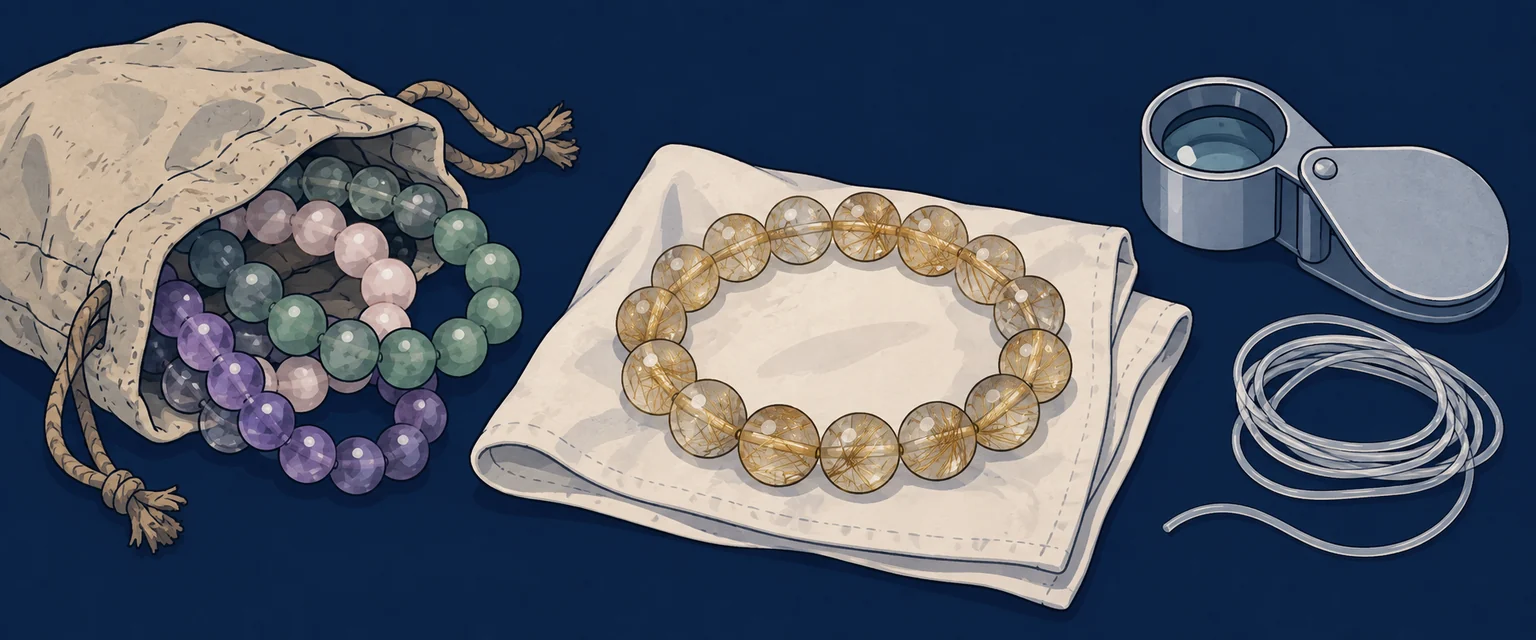
- Sort and examine
- Separate the bracelets and check their cords and beads before deciding how to preserve them. The illustration does not establish a value.
A photo could not tell me what the bag was worth
I first submitted the whole bag for basic identification.
The laboratory explained that identifying a material and estimating its market value are separate services. Instruments can help distinguish quartz, glass, and other minerals, and investigate some treatments and natural or synthetic origin. Value also depends on size, quality, workmanship, condition, and the market at the time.
The initial findings were more complicated than I expected.
Several bracelets were natural quartz, including amethyst, rose quartz, smoky quartz, and quartz with chlorite inclusions. Two had been dyed. One intensely green bracelet that Grandma had considered too precious to wear was actually a glass imitation.
Others were genuine material but ordinary-quality beads with plenty of comparable supply. They did not have exceptional collector value.
Detailed examination confirmed that her everyday bracelet was natural quartz containing many golden, elongated structures. The beads were large and transparent, with dense golden inclusions. Some showed radiating arrangements.
The report described the material and observations. It did not attach a price.
I then asked two specialist crystal shops for valuations. They did not agree on an exact selling price, but both considered the bracelet valuable.
One dealer said it was difficult to find pieces with that combination of size, clarity, and condition, even with money to spend. He believed high-quality material was becoming scarcer and prices would keep rising.
The crystals nobody had wanted, packed in a plastic bag, ended up with the highest combined estimated value among the jewelry Grandma had left us.
Suddenly the family group chat cared about crystals
When I shared the results, my uncle's first question was, “So how much is the bag worth now?”
My aunt wondered whether Grandma's “titanium quartz” really had attracted wealth. Perhaps that was why she wore it while running the shop.
The pieces nobody had wanted suddenly came with a flood of memories.
Someone recalled an amethyst bracelet Grandma bought on a trip to Nantou. Someone remembered that she had given the rose quartz to my aunt after a breakup, and that my aunt later stopped wearing it and returned it. My cousin even asked whether the crystals should be redistributed, since they were also part of the inheritance.
I felt angry and amused at the same time.
When everyone thought the crystals were worthless, they were my keepsakes. Once they might be valuable, they became shared inheritance again.
I remembered the original conversation clearly. My aunt had asked more than once if anyone wanted the bag. My uncle had said, “Then all these crystals go to Mina.” Everyone had nodded.
The discussion stopped after Dad pointed out that we had already made our choices and divided everything fairly. We could not start again just because an identification result surprised us. I had passed up the other jewelry and chosen what nobody else wanted.
My uncle replied with an “understood” sticker.
Had the bracelet really brought Grandma prosperity
For a moment, I wondered whether she had known all along that the bracelet was valuable.
Perhaps she had not bought it casually. Perhaps someone had taught her how to choose crystals. Perhaps she wore it every day not only for its supposed benefits but because she knew it was her finest jewelry.
Then I realized we were filling in a story she had never told us.
We had no purchase record. We did not know what she paid or what the seller said. She really did believe it brought prosperity. It also had material and market value after examination. Those two facts did not prove each other.
The shop's improvement might have come from location, quality, or prices. It might also have come from my grandparents getting up at three every morning to prepare, year after year. A gemological report could not answer whether a crystal had changed their luck.
But I remembered something else.
Before opening, Grandma would touch the beads and say, “Let's work hard and do good business today.”
If the bracelet gave her confidence or reminded her to keep going through the difficult days, that may have mattered to her. It was closer to belief, habit, and companionship than scientific evidence of a mineral's ability to attract wealth.
I did not sell them
A few people heard the news and asked through friends whether I would sell.
I said no.
It was not because I suddenly believed wearing the bracelet would make me rich. After the examination, I was actually more cautious about wearing it casually. A jeweler checked every bead and replaced the cord with a sturdier one, keeping the original order. I saved the old elastic and spare findings in the same plastic bag.
The bag now sits in a humidity-controlled cabinet beside the reports, valuation records, and a photo of Grandma wearing the bracelet.
Sometimes I take it out. The sound of the beads is exactly as I remember it. I can still picture her peeling fruit at the living-room table, the bracelet flashing and clicking whenever she moved her wrist.
If I had looked only at the gold and other jewelry that day, it might have been discarded as cheap costume jewelry or sold to a secondhand dealer for a few hundred.
That experience taught me not to judge crystal value by packaging, trade names, or online asking prices alone. Material, natural or synthetic origin, treatment, bead size, crystal quality, inclusions, and how well the strand is matched can all matter. Identification tells you what something is. Valuation requires a separate look at the market.
Its supposed benefits remain another question.
Grandma believed the bracelet brought her prosperity. My family began believing it mattered once they heard the price.
When I chose it, I had no idea what it was worth.
I just missed Grandma.
Only later did I discover that the bag nobody wanted held the most valuable jewelry she had left behind.
A note on golden rutilated quartz
Golden rutilated quartz generally contains needle-like rutile inclusions in transparent or translucent quartz. “Titanium quartz” is a trade name often used for pieces with coarser rutile inclusions; it does not mean the stone contains metallic titanium.
Size, transparency, inclusion density, arrangement, color, and condition can affect value. Similar-looking items may be glass, dyed material, imitations with added golden strands, or simply ordinary-quality quartz. Choose a reputable seller, and seek professional identification when an expensive purchase raises questions.