The Aura Quartz Debate: Is It a Modern Miracle or Just a Shiny Paint Job?
Edison Cheng
Diploma in Crystal Identification, Gemmological Institute, China University of Geosciences
Published 7 September 2026
Walk into any major gem show today, and you will see them. They sit under the bright lights, glowing like neon rainbows. They look like something from a fantasy movie. They have beautiful names too. Sellers call them Aqua Aura, Angel Aura, or Flame Aura.
Many crystal lovers are obsessed with them. They think these stones carry a special, high-vibrational energy.
But traditional mineral collectors absolutely hate them. They call them ruined. They view them as fake trash.
"Is this a rare geological miracle, or just a clever factory trick?"
That is the question every collector asks sooner or later. People spend a lot of their hard-earned money on these colorful pieces. But if we strip away the marketing stories, the truth is quite simple. These stones are not born with these rainbow colors.
In the gemstone industry, we call them coated quartz.
What is the actual science behind this metallic coat? How does it hold up in real life? Let’s skip the marketing hype and look at the facts.
The Science of the Vacuum Chamber
First, let's be fair. Coated gemstones are not a new scam. The jewelry industry has used surface enhancements for over a hundred years. Even high-end crystal brands use artificial coatings to make their glassware sparkle.
The process used to create aura quartz is called Physical Vapor Deposition (PVD). In plain English, it is vacuum coating.
It is a very cool piece of modern industrial science. Workers take natural, clear quartz crystals and place them inside a tightly sealed chamber. Then, they pump all the air out to create a total vacuum.
Next, they introduce high-purity metals into the chamber. They use real gold, platinum, titanium, or silver. They blast these metals with extreme heat until they vaporize. The metal turns into an invisible mist of floating atoms.
Because of the vacuum, these metal atoms fly at high speeds and bond directly with the surface of the quartz. They stick to the silicon dioxide molecules. The result is a metallic layer that is incredibly thin. We are talking about a few nanometers. It is much thinner than a human hair.
This micro-layer causes a physics phenomenon called thin-film interference. The metal layer bends the light. That is where the magical rainbow reflection comes from.
It is a permanent physical bond. It is not cheap paint. So, if someone tells you that you can wash the coating off with regular tap water, they are wrong. Science says otherwise.
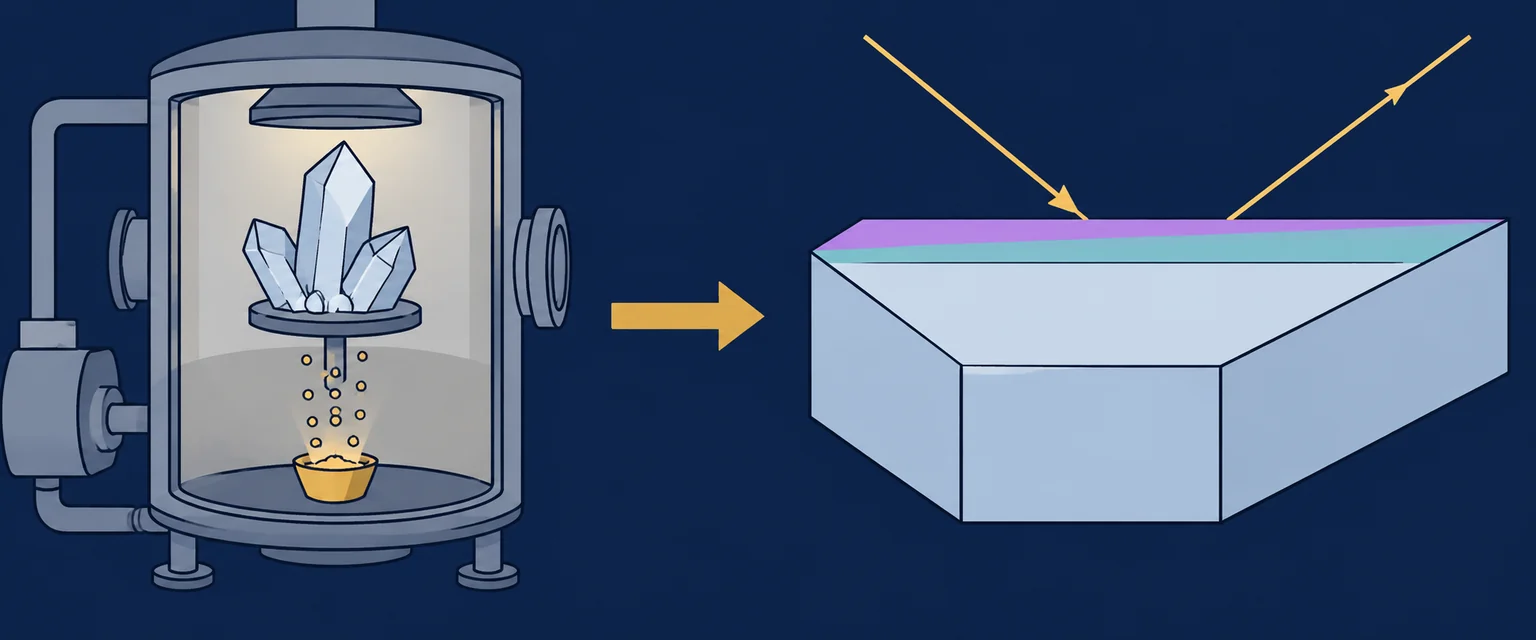
- Surface deposition
- The coating forms on the quartz surface.
- Thin outer film
- The enlarged section separates the surface film from the quartz beneath.
Gold, Platinum, and False Advertising
Different metals create entirely different colors inside the vacuum chamber. In the market, these colors are sold under spiritual names. But to a gemologist, it is just a chemistry checklist:
- Aqua Aura: This happens when you use pure gold. The gold vapor gives the clear quartz a deep, tropical blue color with a sharp metallic sheen.
- Angel Aura: This uses platinum or silver. It creates a soft, pearly sheen. It looks like a unicorn horn, shifting between pale pink, green, and blue.
- Flame Aura: This uses titanium or niobium. It creates a dark, dramatic look. The stones turn deep purple or black, with an oily rainbow shine like a beetle's shell.
| Name in the market | Metal in the chamber | What it looks like |
|---|---|---|
| Aqua Aura | Pure gold | A deep, tropical blue colour with a sharp metallic sheen |
| Angel Aura | Platinum or silver | A soft, pearly sheen, shifting between pale pink, green, and blue |
| Flame Aura | Titanium or niobium | Deep purple or black, with a rainbow shine like a beetle's shell |
These names are clever. They sound rare. But buyers need to stay smart.
The stone underneath the coat is just common, natural clear quartz. It is one of the most abundant minerals on Earth. You are not paying for a rare geological discovery. You are paying for a high-tech factory service.
If a seller is honest and labels the stone as "man-made aura coating," that is perfectly fine. It is a beautiful, fun piece of fashion jewelry. The real problem starts when sellers lie. In the United States, the Federal Trade Commission (FTC) has strict rules about this. Sellers must disclose gemstone coatings. Hiding the treatment to double the price is illegal. It is a trap for unwary buyers.
The Real-World Enemy: Sunscreen and Pool Water
PVD coatings are tough. They do not peel like cheap nail polish. However, if you wear your aura quartz every day, you will eventually face a big disappointment. That micro-thin coat is highly vulnerable to the real world.
It has two major weaknesses that no one tells you about:
1. The Friction Problem
Natural quartz has a Mohs hardness of 7. It is quite scratch-resistant. But the aura coating is made of metal.
The crystal underneath is hard, but the metal layer on top is very soft.
Gold and silver have a hardness of only 2.5 to 3. If you wear an aura quartz bracelet, the beads will rub against each other constantly. Your wrist will brush against wooden desks or metal zippers. Over a few months, this friction will slowly grind the metal layer away.
The coat will not slide off in one piece, but it will wear thin. Eventually, the sharp edges of your beads will lose their rainbow color. They will turn into plain, clear glass-like quartz again. It is irreversible physical wear.
2. The Chemical Attack
On a microscopic level, these ultra-thin metal layers hate harsh chemicals.
Many people wear their jewelry into the backyard swimming pool or the hot tub. That is a huge mistake. The high amount of chlorine in pool water eats away at the metal atoms.
The same thing happens when you apply sunscreen, spray perfume, or sweat heavily during the summer. The acids and chemicals react with the thin metal coat. Over time, the chemical reaction causes the metal to oxidize. Your shiny rainbow bracelet will turn dull, foggy, and gray.
Enjoy the Beauty, But Know the Truth
We always say that the best collector is an informed collector.
If you want to buy an aura quartz piece because you love the neon colors, go for it. It is a beautiful piece of modern art. Just remember to take it off before swimming, keep it away from perfumes, and treat it gently. It will stay pretty for a long time.
But if you are buying it as an investment, or because you want an untouched piece of ancient earth history, you are looking at the wrong stone.
True appreciation starts with science, not stories. When you understand how a gemstone is actually made, you can make smart choices. We love exploring the facts behind the trends, and we will keep sharing the real science behind your favorite minerals in our upcoming articles. When you stop chasing fancy names, you can truly enjoy the hobby.
Industry References for Material Stability
To learn more about gemstone coatings and consumer protection laws, you can read the official guidelines from these leading international institutions:
- GIA (Gemological Institute of America) – Gem Encyclopedia: Quartz Treatments
The official guide explaining how vacuum deposition works on quartz and how gem labs identify surface modifications. - AGTA (American Gem Trade Association) – Gemstone Information Manual
The industry-standard rulebook on disclosure codes for surface coatings (C) and the proper care instructions for buyers. - FTC (Federal Trade Commission) – Guides for the Jewelry, Precious Metals, and Pewter Industries
The official government regulations regarding consumer rights and the legal requirement to disclose artificial gemstone treatments.