Home → Identification guides → Moldavite
From a Cosmic Crater to a Green Beer Bottle: The Epidemic of Fake Moldavite
Edison Cheng
Diploma in Crystal Identification, Gemmological Institute, China University of Geosciences
Published 10 September 2026
Walk into any major gem show today, and you will see a massive crowd around the meteorite dealers. People are fighting to get a look at a very strange, moss-green stone. It is not smooth. Its surface is covered in deep, wild wrinkles and sharp ridges.
The price tags are unbelievable. A piece smaller than a coin can cost a small fortune.
Sellers call this legendary green stone Moldavite.
If you scroll through TikTok or Reddit, you will find endless stories about it. People claim it is a stone of intense spiritual transformation. The marketing story sounds like a Hollywood movie plot. They say a massive asteroid crashed into Earth millions of years ago. The heat was so intense that it melted the ground and blasted a rain of cosmic green glass across the fields.
It sounds like the ultimate space adventure.
Many crystal lovers spend their life savings to own a piece of this star-born magic. But if we take some of the beautiful, flawless Moldavite pieces sold online and look at them under a professional microscope?
The illusion breaks instantly. The reality is pretty brutal. In many cases, that rare green treasure is just a melted Heineken bottle poured into a cheap factory mold.
What is the actual science behind this viral green stone? How do experts classify it? Let’s look at the hard facts without the marketing hype.
1. It Really Is Glass, But It Is Earth's Birthmark
First, let's look at the science. Moldavite is glass.
In gemology, we call it a tektite. About 15 million years ago, a massive meteorite slammed into Europe. The impact generated unbelievable heat and pressure. It instantly melted the local sand and rocks, blasting the liquid high into the atmosphere.
This molten spray cooled down as it flew through the air, falling back down as green droplets.
It is a genuine geological miracle. But it is not made of alien material. It is 99% silicon dioxide from our own planet. Its true value comes from the fact that it is a physical record of a catastrophic historic impact.
Natural impact glass always looks wild and uneven.
Real Moldavite has a chaotic surface. It was shaped by wind, air explosions, and millions of years of micro-acid erosion from groundwater. Every single piece has a unique shape. If you see a seller online with fifty pieces that all have identical, uniform wrinkles, walk away. That is a clear sign of factory-made glass.
| What you see | What it usually is | How to tell |
|---|---|---|
| A chaotic surface, and every single piece has a unique shape | Real Moldavite | Shaped by wind, air explosions, and millions of years of micro-acid erosion from groundwater |
| Fifty pieces that all have identical, uniform wrinkles | Factory-made glass | That is a clear sign of factory-made glass |
2. The Price Bubble and the Reality of Lab Documents
Stories sell much faster than mineral science. That is just how the modern crystal market works.
Because Moldavite only exists in one specific region, the natural supply is disappearing. Local governments have heavily restricted legal mining. Sellers love using this scarcity to pump up the prices.
But if you send your high-priced green stone to a major, independent gem lab, look at the paperwork. Under the "Species" line, the lab will print one phrase: Natural Glass. They will add a short note identifying it as a tektite or Moldavite.
A serious gem lab will never write anything about outer space energy or cosmic power.
This is a major blind spot for new collectors. People buy a piece online because they want a piece of the cosmos. Later, they try to resell it or get a formal appraisal, only to find out it is scientifically classified the same way as volcanic obsidian. You are paying a huge premium for the folklore, not a precious gemstone material.
There is no reason to hate natural glass. Under a lens, real tektites hold a beautiful microscopic world of elongated bubbles and swirling lines. If you buy it because you love the history of the impact, it is an incredible piece of art. But if you are chasing a magical story, you might be setting yourself up for disappointment.
3. The Unspoken Danger: Glass Is Still Brittle
Beyond the fakes, Moldavite has a major structural weakness that sellers rarely talk about. It shatters very easily.
We often think of minerals like quartz as tough. They have a Mohs hardness of 7 and can take a beating. But Moldavite behaves exactly like a kitchen window.
Its hardness sits around 5.5 to 6. This means its scratch resistance is quite low. Everyday items like a steel pocket knife or coarse beach sand can easily scratch the surface of your expensive stone.
Worse, it has no internal crystal structure. It is amorphous glass.
When you drop a crystal, it might split along a clean line. But when you hit glass, it breaks in a circular, jagged pattern called a conchoidal fracture.
This creates a real issue for jewelry. If you wear a Moldavite bracelet or ring every day, the beads will bump into things. You might tap your hand against a granite countertop or a car door. The sharp, delicate ridges on the stone will chip instantly. Over time, those beautiful wrinkles will look foggy and blunt. It is permanent, physical wear.
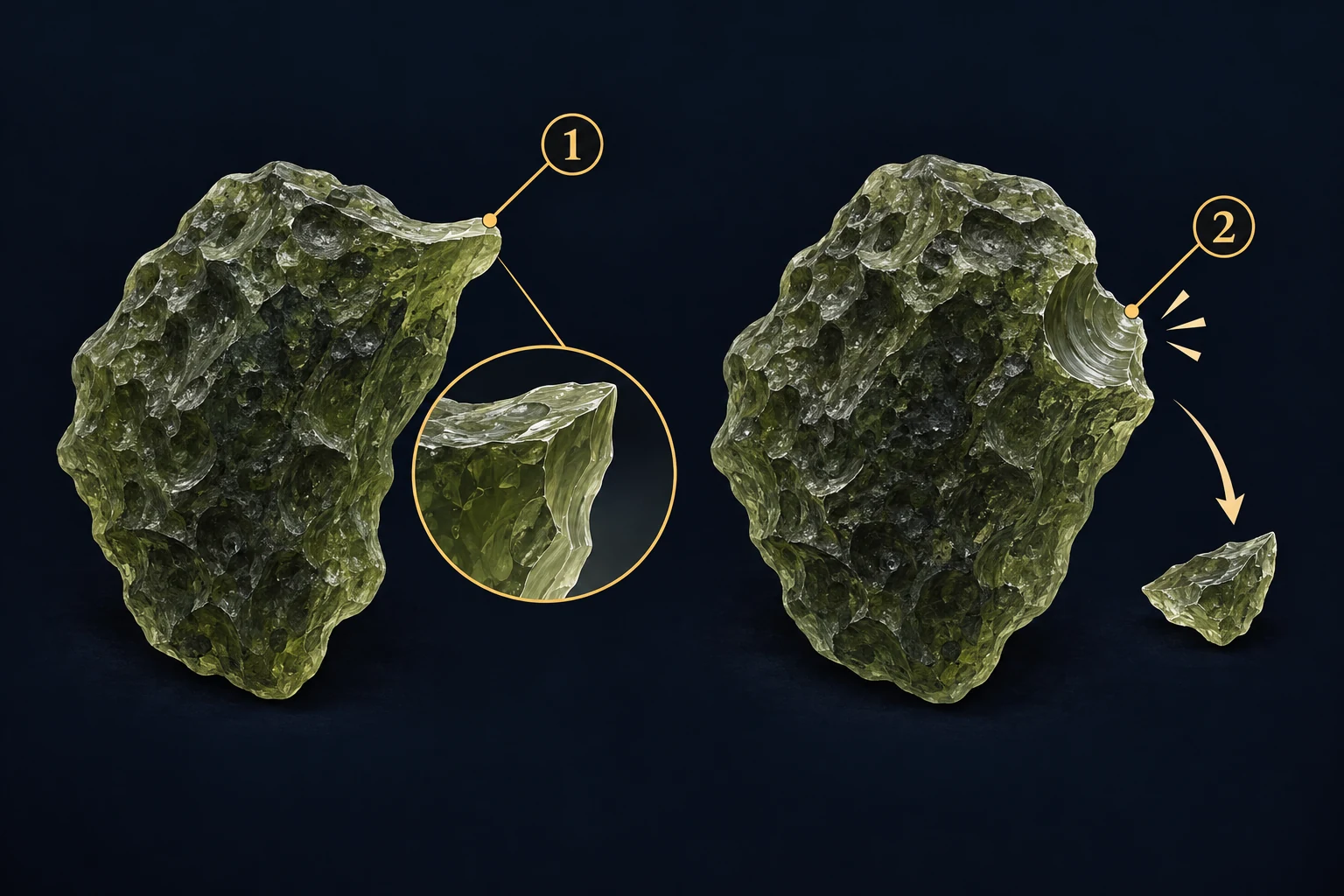
- 1A projecting edge
- Thin edges deserve attention during wear and handling.
- 2A chipped edge
- The curved fracture surface and detached chip illustrate local impact damage.
4. True Appreciation Starts with Facts
Collecting rocks is a wonderful journey, but the smartest buyers always focus on facts over hype.
The modern internet is flooded with fancy trade names and manufactured scarcity. It is very easy to lose your savings on a clever story. But the raw, unedited thumbprints left by our planet are beautiful enough. They do not need an artificial script to be fascinating.
When you look past the commercial legends, you can appreciate the true nature of the material. You can admire the swirling lines inside the glass and the sheer power of the ancient impact that made it. Genuine value comes from understanding the physics, not the folklore.
We love exploring the real science behind trending minerals, and we will keep breaking down the facts in our upcoming articles. When you stop buying the hype, you can finally enjoy the real hobby.
Industry References for Material Stability
To learn more about the physical properties and identification of impact glasses, consult the official literature from these leading international bodies:
- GIA (Gemological Institute of America) – Gem Encyclopedia: Tektite Varieties and Market Impositions
The official laboratory guide explaining the distribution, formation, and naming standards for natural glasses. - GIA (Gems & Gemology) – Investigation of Massive Moldavite Imitations
A deep-dive research paper analyzing how modern factories use green glass and custom molds to create highly deceptive fakes. - Mindat.org – Moldavite / Tektite Physical Properties and Chemical Stability Database
The world’s largest public earth science database, providing peer-reviewed crystal data on the brittleness and fracture mechanics of amorphous silica.