The Silent Agreement of the Tanzanite Industry: Born Brown, Baked Blue
Edison Cheng
Diploma in Crystal Identification, Gemmological Institute, China University of Geosciences
Published 12 September 2026
Look into the window of any high-end jewelry boutique. You will immediately notice a mesmerizing gemstone. It features a unique, deep color that blends rich royal blue with velvety purple. At different angles, it flashes hints of burgundy. Gemologists call this dramatic optical trait pleochroism. It has made tanzanite one of the most coveted items in the modern luxury market.
Retail advertisements love to frame this stone as an absolute geological miracle.
The marketing copy usually reads like poetry. "Mined only at the foot of Mount Kilimanjaro. Forged over millions of years by intense subterranean pressure to capture the deep blue soul of Africa."
It sounds incredibly exotic. It makes the high price tag seem completely justified.
Because of these romantic legends, buyers invest heavily in this natural blue miracle. They pay premium prices that rival fine blue sapphires. But what if we trace this gemstone back to its very beginning? What does it look like when it first leaves the mine shaft?
The reality might shock a new collector.
Without a 450°C industrial oven, that expensive gemstone on your finger would not look royal blue at all. It would look like a common brown pebble you found on the side of the road.
What is the scientific truth behind this industrial baking process? How should consumers view their legal rights when buying treated stones? Let’s put the marketing myths aside. It is time to look at the objective gemological facts behind tanzanite's true origin.
1. The True Nature of Zoisite: The Mineral World's Ugly Duckling
First, we need to understand the true identity of this stone under a microscope.
In gemological science, tanzanite is not a standalone mineral species. It is simply a commercial trade name. The actual mineral belongs to a family called zoisite.
When miners first dig zoisite out of the ground, the raw crystals are incredibly dull. The crystal lattice naturally traps iron, titanium, and vanadium impurities during growth. Because of these mixed elements, rough zoisite typically displays a muddy yellow-brown color. Sometimes it just looks like gray dirt.
This is completely normal. In nature, it is incredibly rare for subterranean magma to hit the perfect temperature to turn the stone blue naturally. Untreated, earth-heated blue zoisite is an extreme rarity in the gemstone market.
So where does the endless supply of uniform royal blue tanzanite come from?
It comes from standard modern lab enhancement. Gem cutters take the raw brown zoisite and place it inside high-tech industrial ovens. They slowly ramp up the temperature to about 450°C to 500°C. In gemology, this standard procedure is officially called heat treatment.
Under this extreme heat, the vanadium atoms inside the zoisite alter their valence state. This micro-structural change alters the way the stone absorbs light. The dull brown hue completely vanishes. It leaves behind the vivid, deep blue-violet color that consumers love.
It is a permanent transformation completed inside a factory oven.
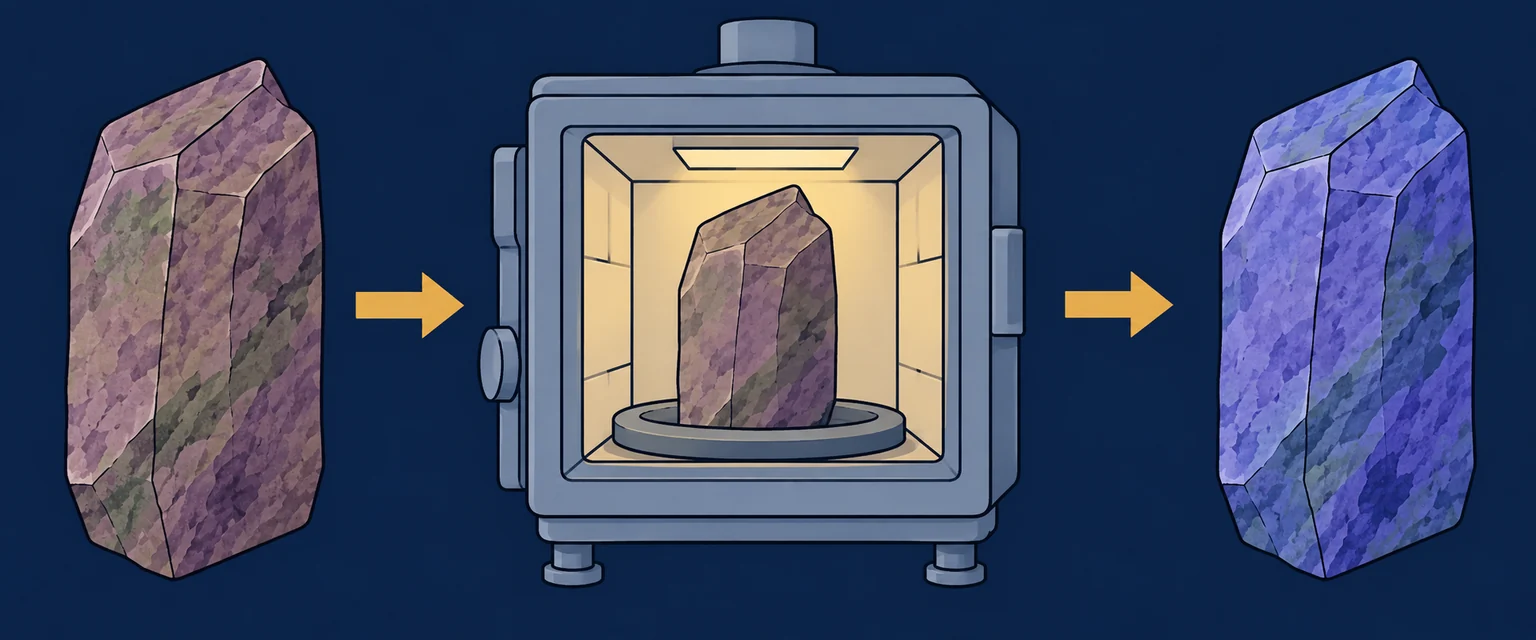
- Brownish zoisite
- The starting material is shown with a brownish colour component.
- Controlled heating
- The furnace represents heat treatment, not a home-treatment recipe.
- Blue-violet appearance
- Heat treatment can reduce the brown component and reveal blue-violet colours.
2. Enhancement vs. Fraud: The Global Legal Boundary
Many consumers feel cheated when they first discover this oven secret. They wonder if heat treatment is just a fancy word for forgery.
That is a misunderstanding. In the international gemstone trade, heat treatment is a fully accepted, fully legal enhancement.
It is completely different from deceptive practices like surface coating, color dyeing, or injecting colored plastics into a stone.
Heating tanzanite does not add any foreign chemicals to the crystal. The chemical formula of the zoisite remains identical. It simply uses controlled temperatures to recreate what nature started but did not finish. Furthermore, the resulting blue color is completely stable. It will never fade or revert to brown under normal wear.
Because it is safe and stable, major global labs like the GIA (Gemological Institute of America) treat heat treatment as a standard, expected enhancement for tanzanite.
However, there is a strict legal line that sellers cannot cross. It is called consumer disclosure.
In strict regulatory markets like the United States, the FTC (Federal Trade Commission) enforces rigid transparency laws. Retailers must clearly state on the price tag or invoice if a gemstone has been heated. The real scam in the market is not the heat treatment itself. The fraud happens when dishonest dealers hide the fact. They take a standard, oven-baked tanzanite and market it as an "unheated museum-grade miracle" to double the price. Hiding the science to sell a myth is a major consumer trap.
3. The Structural Blind Spot: Why Ultrasonic Cleaners Destroy Tanzanite
Beyond the disclosure debate, tanzanite has a physical vulnerability that buyers regularly ignore. It can easily shatter inside an acoustic cleaning machine.
Tanzanite has a Mohs hardness of 6.5 to 7. While it is softer than sapphire, it is durable enough for normal jewelry wear if handled with basic care. The real danger happens during routine cleaning. Many owners buy small ultrasonic jewelry cleaners for their homes to strip away body oils and grime.
Putting tanzanite into these machines is a massive mistake.
The danger comes from a specific crystallographic property: perfect cleavage. This means the atomic bonds inside a tanzanite crystal are structurally weak along one specific flat plane.
An ultrasonic cleaner works by blasting jewelry with high-frequency physical vibrations. This creates intense acoustic resonance. If these microscopic shockwaves hit the stone at the exact angle of its perfect cleavage plane, the pristine tanzanite can instantly split apart.
This is not a theoretical warning. It is a well-documented disaster that happens in retail stores and gem labs worldwide.
Daily maintenance for tanzanite should be straightforward: avoid heavy impacts, and ban all ultrasonic or steam cleaning. If your ring gets dirty, stick to a simple, manual routine. Use lukewarm water mixed with a single drop of mild dish soap. Take a soft-bristled brush and gently clean the pavilion facets. Wipe it dry immediately with a clean microfiber cloth.
Tanzanite care at a glance
| Point | What the article says |
|---|---|
| Mohs hardness | 6.5 to 7 — softer than sapphire, but durable enough for normal jewelry wear if handled with basic care |
| Structural weak point | Perfect cleavage: the atomic bonds inside the crystal are structurally weak along one specific flat plane |
| Never do this | Ultrasonic cleaning, steam cleaning, heavy impacts |
| Correct cleaning | Lukewarm water mixed with a single drop of mild dish soap, a soft-bristled brush on the pavilion facets, wiped dry immediately with a clean microfiber cloth |
| Does the blue fade back to brown | No. The blue is completely stable and will never fade or revert to brown under normal wear |
4. Rational Collecting: Appreciating the True Gemstone
True appreciation for jewelry requires looking past the romantic marketing copy and seeing the physical reality of the material.
There is no reason to look down on tanzanite just because it requires heat to unlock its beauty. There is also no reason to avoid it just because it possesses natural cleavage. The harmony between ancient geological forces and modern technical enhancement is exactly what allows this African mineral to shine on your finger.
When shopping for colored stones or crystals, your healthiest strategy is to demand full disclosure. Do not fall for unrealistic "untreated" folklore, and never pay inflated prices for unverified trade names. Real value comes from clear science, not manufactured mysteries. We look forward to breaking down the physics behind more popular mineral trends in our upcoming articles, helping you shop with absolute clarity.
Industry References for Material Stability
- GIA (Gemological Institute of America) – Gem Encyclopedia: Tanzanite Quality Factors and Heat Treatments
The definitive educational reference on the valence state changes of vanadium impurities in zoisite crystals under controlled thermal enhancement. - AGTA (American Gem Trade Association) – Gemstone Information Manual: Code of Disclosure for Thermal Enhancement (H)
The official trade manual outlining standard international disclosure symbols, consumer protection regulations, and specific care restrictions for heated zoisite. - FTC (Federal Trade Commission) – Guides for the Jewelry, Precious Metals, and Pewter Industries: § 23.22
Federal consumer protection laws requiring the absolute disclosure of artificial gemstone enhancements and thermal treatments at the retail point of sale.