Home → Identify → Six Crystal Identification Myths That Do Not Prove Your Quartz Is Natural
Six Crystal Identification Myths That Do Not Prove Your Quartz Is Natural
Edison Cheng
Diploma in Crystal Identification, Gemmological Institute, China University of Geosciences
Published
English edition of the original Chinese article.
“Can someone tell me if this crystal is real?” It is probably the most common question in a crystal group. The answers arrive just as quickly: put it over printed words, look for cloudy inclusions, feel whether it is cold, or try scratching glass.
None of those gives you a dependable answer on its own. The observations are not all meaningless, but can you use them to establish whether a piece is natural quartz? Honestly, no.
Here are six popular home tests, what they actually tell you, and where their logic breaks down.
The short version: even if you try all six, you still cannot be certain. They also tell you very little about common imitations, synthetic quartz, or treatments such as dyeing, fracture filling, coating, heating, and irradiation.
Dye detection is especially poorly explained online. Misleading advice gets shared repeatedly and can even appear in search summaries. We will look at what to examine instead, then tackle the material that creates the biggest challenge for gemologists: synthetic quartz.
Six common myths
1. Double images over printed text prove it is natural quartz
This is one of the most widely repeated tests, and one of the most misleading.
It is poorly suited to ordinary beads and small crystal objects. Seeing a doubled image does not prove that a piece is natural quartz. Failing to see one does not rule natural quartz out, either.
Quartz has a birefringence of about 0.009. In the example used here, an 8 mm bead separates the two images by approximately 0.047 mm. At a reading distance of 25 cm, the smallest separation the unaided eye can resolve is roughly 0.07 mm. The bead's curved surface also distorts the letters, so what you notice may be blur rather than two distinct images.
A 10× loupe could make that 0.047 mm separation appear about 0.47 mm wide. Even then, the result may look like a faintly blurred edge rather than two clear lines. Interpreting it still calls for experience or appropriate instruments.
Calcite is the classic example of obvious image doubling. Its birefringence is about 0.172, and a 1 cm thick piece can produce a separation of roughly 1.1 mm. Many online demonstration photos show this effect rather than a reliable test for quartz.
If you have a sufficiently thick piece of transparent calcite, also called Iceland spar, doubled text may be easy to see. That does not make the same approach a sensible identification test for a small quartz bead.
2. Flawless quartz is fake and cloudy quartz is real
This assumption can make you pass up good material while paying more for poor-quality pieces.
High-quality natural quartz can be free of visible clouds and fractures. That can help explain its price; it is not evidence that the stone is fake.
Conversely, many dyed or resin-filled pieces already contain clouds and fractures. Lower-quality material may be heavily treated precisely because those fractures give dyes and fillers a route into the stone.
The shape and character of inclusions can help a trained gemologist identify a material. The rule is not “flaws mean real, no flaws mean fake.” Still, a piece that is intensely colored, apparently flawless, and unusually cheap deserves a closer look.
3. Quartz feels colder than glass
There is a physical reason behind this idea, but the difference is hard to judge reliably by touch.
Quartz has a thermal conductivity of roughly 6–11 W m⁻¹ K⁻¹, compared with about 1 W m⁻¹ K⁻¹ for glass. Quartz can therefore conduct heat away more readily.
However, the sensation of coolness depends on thermal effusivity: how effectively a material draws heat from your finger. That depends on conductivity, density, and specific heat capacity together, not conductivity alone.
Quartz and glass have fairly similar density and specific heat capacity. The difference you feel is much less dramatic than the conductivity figures might suggest. Glass can feel cool, too. Touch is not a dependable identification test.
4. Anything that scratches glass must be quartz
Quartz has a Mohs hardness of 7, while ordinary glass is around 5.5. Quartz can scratch glass, but so can many other materials.
Topaz has a hardness of 8, zircon is about 7.5, and corundum is 9. Synthetic quartz also has a hardness of 7.
A scratch result does not uniquely identify quartz, and it cannot distinguish natural quartz from synthetic quartz.
5. Perfectly straight needles mean rutilated quartz is fake
Straight needles are not, by themselves, a warning sign.
The “hairs” in rutilated quartz are usually rutile inclusions. Rutile naturally forms needle-like crystals, which can be straight, rigid, and clearly defined. Intersecting networks, including needles crossing at approximately 60 degrees, also occur.
Needles may be straight or curved. That distinction alone does not settle whether the quartz is natural.
6. All citrine is heated amethyst so all citrine is fake
The conclusion confuses treatment with imitation.
Natural-color citrine exists. Amethyst that has been heated to produce a yellow color is still quartz of natural origin, with a heat treatment; it has not become glass or another imitation material.
Telling natural-color citrine from heat-treated material by eye can be difficult. An examination may include a dichroscope, but the question is not settled by a visual guess.
Dyed quartz requires a different question
The six myths above do not establish whether quartz has been dyed. Four suggestions frequently offered online are to look for inclusions, check for bubbles, feel the stone's temperature, and look for double refraction.
These suggestions concern the material's identity, not the origin of its color. Dyed quartz is usually still quartz. It may have inclusions, feel cool, lack obvious round bubbles, and retain quartz's optical properties.
To investigate dyeing, follow the color.
Look at where the color collects
Dye enters from outside, through openings such as fractures, boundaries, and pores. Under magnification, color concentrated in those openings can provide evidence of treatment. Some manufacturing processes deliberately create fractures so that dye can penetrate the material.
Natural quartz color arises from trace elements or color centers within the crystal structure. It can appear in zones related to crystal growth. Amethyst often shows angular color zoning; some material from Morocco shows hourglass-like patterns.
The useful distinction is not “uniform versus uneven.” It is whether the color follows growth features or concentrates along fractures in a network of lines.
Two cautions matter:
- Natural color is not necessarily uniform. Color zoning is common in amethyst, and it should not automatically be mistaken for dye.
- Yellow-brown or reddish-brown material in fractures may be natural iron-related staining. Experience or further testing may be needed to distinguish it from treatment.
| Color observed in fractures | How to interpret it |
|---|---|
| Yellow-brown or reddish-brown | May be iron-related; needs closer examination |
| Green, blue, bright pink, or purple concentrated along fractures | Strong reason to investigate dye treatment |
Drill holes can be useful places to look. If a bead is drilled before dyeing, color may collect along the hole walls. If it is drilled after dyeing, drilling may expose a paler area beneath a colored surface.
Compare the hole walls with the surrounding bead rather than assuming that either dark or light walls alone prove dyeing. The GIA example cited for this general observation concerns dyed pearls, not a quartz-specific diagnostic rule.
Synthetic quartz is the harder problem
Glass is among the more straightforward crystal imitations to identify. Hydrothermally grown quartz is a much greater challenge.
In this process, silica dissolves in an alkaline solution under high pressure and crystallizes on a seed plate. The result is actual quartz grown in a laboratory.
Its composition and crystal structure are very close to those of natural quartz. Both can have a hardness of 7, a specific gravity around 2.65, and refractive indices of approximately 1.544–1.553. Synthetic material can also show color zoning and inclusions.
“Very close” does not mean identical in every respect. Trace elements and structural defects can differ, but identifying those differences may require laboratory instruments.
The difficulty is not merely that a home test is imprecise. The properties it measures often do not offer a decisive distinction in the first place.
| Property or feature | Natural quartz | Synthetic quartz | Useful for distinguishing origin |
|---|---|---|---|
| Main composition | Silica | Silica | Not by itself |
| Mohs hardness | 7 | 7 | No |
| Specific gravity | About 2.65 | About 2.65 | No |
| Refractive index | 1.544–1.553 | Comparable | No |
| Color zoning and inclusions | Can occur | Can occur | Not simply from their presence |
| Brazil-law twinning | Common | Generally absent in the comparison discussed here | May be useful with polarizing equipment |
| Remnants of a seed plate | Not a growth feature of natural quartz | May occur | Requires close examination, often microscopy |
| Breadcrumb-like inclusions | Not listed for natural quartz in this comparison | May occur | Requires microscopy |
The last three are the kinds of features that can help a specialist. They require instruments and interpretation, and they are not present in every specimen.
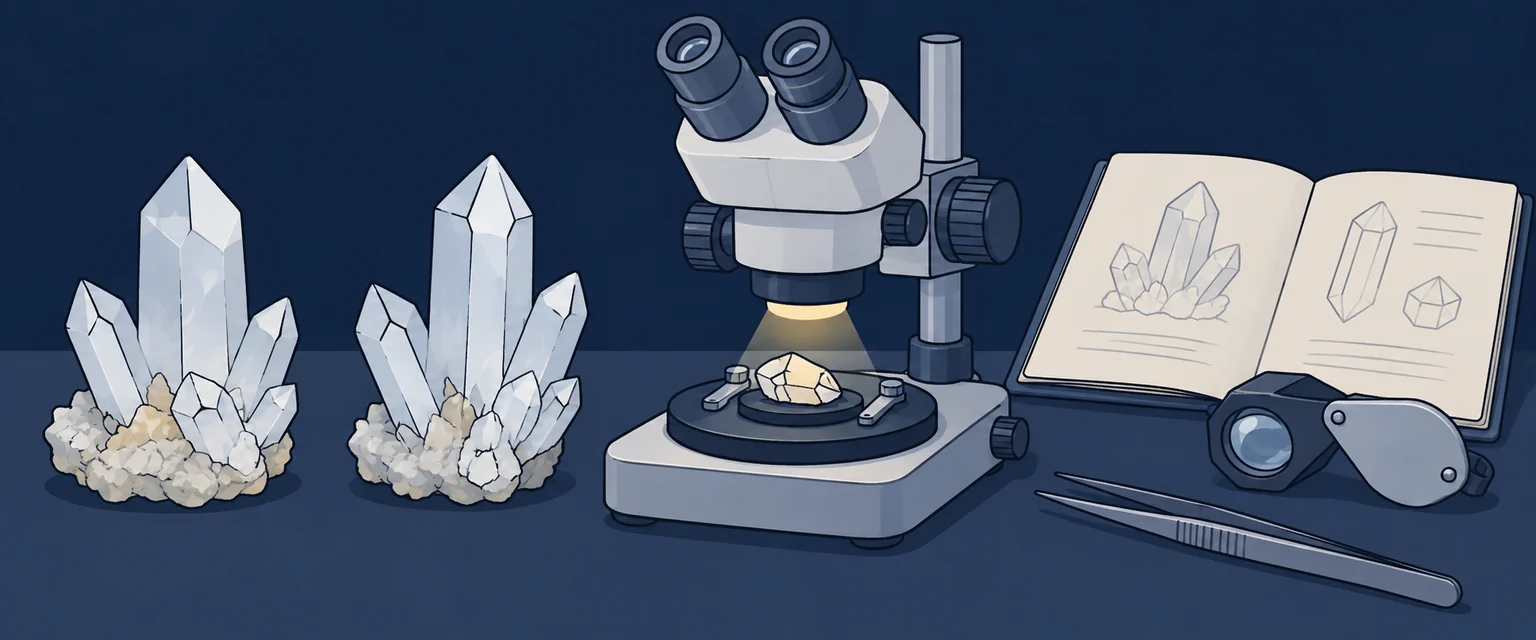
- Observe, then assess
- Appearance, inclusions and measurements provide different evidence. One visual feature is not a complete identification.
What a buyer can actually check
“Is it real?” combines several different questions. Separate them before choosing a test.
| Question | Possible clues | Can a beginner settle it by eye |
|---|---|---|
| Could this be glass | Round bubbles or manufacturing seams | Visible clues can help; their absence does not clear a piece |
| Could it be dyed | Color concentrated in fracture networks | Obvious examples may be recognizable |
| Could it be fracture-filled | Uneven luster or unusual reflections in fractures | Sometimes; interpretation can be difficult |
| Is it natural or synthetic quartz | Twinning, seed remnants, or diagnostic inclusions | Usually not without instruments |
| Has it received another treatment | Depends on the treatment | Often requires experience or additional testing |
For everyday shopping, start with four practical steps.
- Look for visible clues. Round bubbles or manufacturing marks may suggest glass; color concentrated along fractures may suggest dyeing; an unusual surface sheen or worn coating edges may suggest a coating.
- Put the price in context. A vivid, flawless-looking piece at a surprisingly low price is a reason to ask more questions, not a diagnosis.
- Ask the seller directly: “Is this natural or laboratory-grown?” and “What treatments has it received?” Keep a reliable written record of the answers.
- For an expensive piece or a substantial purchase, ask about a report from a reputable independent laboratory, or arrange testing.
When these checks can fail
Manufacturing seams may be polished away, and higher-quality glass imitations may contain few visible bubbles. Seeing a relevant feature can be useful; failing to see it is not proof of natural origin.
Price comparisons fail when inexpensive material is priced as a premium product. Seller questions fail when the seller lacks knowledge or does not answer honestly. Pay attention to expertise and sales practices as well as confident claims.
Written records and reports may also be difficult to act on in a cross-border transaction. The seller may be in another jurisdiction, and an account or contact method can disappear.
One often-overlooked point: examine beads individually. A bracelet can contain a mixture of materials. A favorable result for one or two beads does not clear the entire strand.
Common questions
Is there a single test that always works
No. The unaided eye and a 10× loupe can help identify some glass imitations and obvious dye treatment, but no instrument-free method can establish natural versus synthetic origin with complete certainty.
How can I reduce the risk before buying
Ask whether the material is natural or laboratory-grown and whether it has been treated. Keep the answers in writing. Be cautious when the price is far below comparable material, and consider independent testing for an expensive purchase. If natural origin is important to you, specifically ask the laboratory whether its examination covers that question.