Home → Insights → Turquoise & malachite
The Hidden Chemistry of Bohemian Style: Why Turquoise and Malachite Hate the Shower
Edison Cheng
Diploma in Crystal Identification, Gemmological Institute, China University of Geosciences
Published 11 September 2026
Look at any Bohemian or Southwestern jewelry display. You will see a lot of silver. But you will also see two specific colors. They are forest green and sky-blue. These colors come from two very popular gemstones. Turquoise and malachite.
Sellers often give these stones romantic stories. They call them raw products of the earth. They say these gems have soothing properties. They tell buyers to wear them constantly.
Many people believe this narrative. They buy a beaded bracelet. They buy a silver ring. Then, they simply leave the jewelry on. They wear it to the gym. They sleep in it. Most commonly, they wear it in the shower.
But this constant wetness causes a real problem. It is a bad habit from a material standpoint. Why? Because these minerals have a very delicate chemical makeup. They are fundamentally incompatible with the modern bathroom.
You need to understand the basic mineralogy behind these green gems. It is the only way to protect your collection. Let’s look at the actual physics and trade realities. No marketing stories. Just facts.
The Copper Vulnerability: Why Malachite Turns Dull
Malachite is famous for its circular bands. The look is very striking. But the chemistry requires a careful approach.
In gemology, malachite is a copper carbonate mineral. It forms as a natural byproduct near copper ore deposits. That deep green color comes entirely from the presence of heavy copper elements. They sit inside the crystalline structure.
Because it is a copper-based carbonate, malachite has a major weakness. It reacts easily when it touches acids, bases, or domestic chemicals.
This creates a regular maintenance issue. Think about a hot shower or a heavy workout. The gemstone encounters an aggressive chemical environment. Human sweat contains weak acids. Standard body washes and shampoos contain alkaline compounds. These chemicals trigger a slow reaction on the stone’s surface.
This reaction alters the polished exterior. It happens gradually. Over time, the vibrant, glossy green turns foggy. The finish becomes dull and matte.
Furthermore, prolonged exposure to moisture can cause trouble. The material can release trace copper ions on its surface. Do you have highly sensitive skin? Do you have small cuts on your wrist? This metallic contact can lead to localized skin irritation. It can cause redness.
In the preservation world, malachite is treated as a delicate specimen. It belongs in a stable, dry environment. Introducing it to hot, soapy water is an unnecessary risk. It hurts the gemstone. It can also irritate your skin.
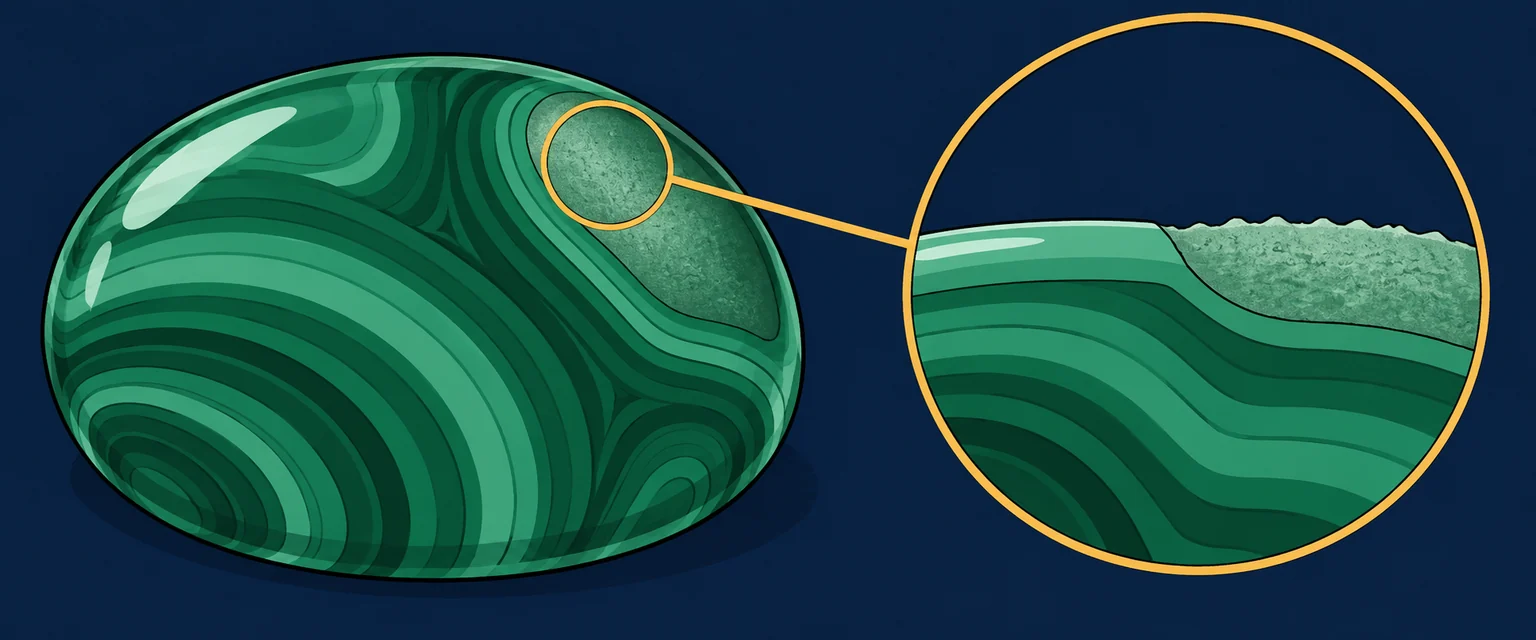
- A polished surface
- The banding remains visible beneath the smooth finish.
- A changed surface patch
- Contact with an unsuitable cleaning product can affect the finish; the inset enlarges the local change.
Cryptocrystalline Architecture: The Sponge-Like Nature of Turquoise
Turquoise presents a different structural challenge. Many consumers assume it is a sturdy, carefree stone. They think this because its Mohs hardness sits around 5 to 6.
But that is a misconception. It is based on a misunderstanding of mineral structures. Under a microscope, turquoise is cryptocrystalline. This means it is not a solid, single crystal. Instead, it is a dense aggregate. It is made of millions of sub-microscopic crystals packed tightly together.
This specific architecture changes everything. It leaves the stone full of invisible, microscopic pores. It behaves much like a rigid, mineral sponge.
When turquoise touches tap water, cosmetics, or perfumes, its porous nature takes over. Through capillary action, the gemstone absorbs moisture. It also sucks in any chemical impurities dissolved in the water. The chlorine in domestic water builds up inside. The artificial fragrances in lotions stay there. Body oils slowly fill these microscopic voids.
Once inside, these chemical residues oxidize. This process takes months and years. This internal chemical change alters the optical appearance of the stone. The clean, iconic sky-blue gradually shifts. It turns into a muddy, dull yellowish-green.
In gemology, we have a name for this. It is called irreversible environmental discoloration.
To stabilize this material, the modern gem trade relies on a standard procedure. It is called stabilization. Producers place lower-density turquoise into high-pressure chambers. Then, they inject it with clear acrylic resin. This fluid seals the microscopic pores. It locks out moisture. It increases the stone's durability.
Under global trade standards, stabilized turquoise is perfectly acceptable. It is a durable and budget-friendly jewelry choice. But the dealer must provide clear disclosure. The real issue arises when sellers use deceptive terminology. Or when they dye a cheap white mineral like howlite to pass it off as premium, untreated turquoise. Full disclosure remains your best protection.
| Stone | What it is made of | What the shower does to it |
|---|---|---|
| Malachite | A copper carbonate mineral; the deep green color comes entirely from the presence of heavy copper elements sitting inside the crystalline structure | Weak acids in human sweat and alkaline compounds in body washes trigger a slow reaction on the surface: the vibrant, glossy green turns foggy, dull and matte, and prolonged moisture can release trace copper ions |
| Turquoise | Cryptocrystalline — not a single crystal but a dense aggregate of millions of sub-microscopic crystals, full of invisible pores; it behaves much like a rigid, mineral sponge | Capillary action pulls in chlorine, artificial fragrances and body oils; the residues oxidize inside and the iconic sky-blue shifts to a muddy, dull yellowish-green — irreversible environmental discoloration |
Balance and Preservation: A Practical View
An experienced collector views minerals through objective science. No fear. No marketing hype. Every gemstone created by geological forces has its own physical and chemical boundaries.
When shopping for green-blue gemstones, request full disclosure. Ask about dye or resin treatments. Understanding the exact nature of the material ensures proper care over the long term.
The maintenance rule for these specific minerals is simple. Remove them before heavy exercise. Keep them out of the bathroom. Apply perfumes or lotions before putting your jewelry on.
For routine cleaning, skip the domestic detergents. Do not use chemical solutions. A gentle wipe with a clean, dry microfiber cloth is enough. That is all that is required. Respecting the natural chemistry of your stones keeps them pristine for years.
Industry References for Material Stability
- AGTA (American Gem Trade Association) – Gemstone Information Manual
The official trade guidelines defining the stabilization codes for turquoise and the legal requirements for disclosing dyed mineral imitations. - GIA (Gemological Institute of America) – Gem Encyclopedia: Turquoise Quality Factors
An educational breakdown on the cryptocrystalline porosity of aggregate gemstones and their long-term reaction to environmental variables. - GIA (Digital Research Archive) – Chemical Reactivity of Carbonate Minerals
A professional gemological reference detailing the acid sensitivity of copper-based carbonates like malachite when exposed to domestic surfactants.